The Concept Exploration Platform for High-Performance Structural Parts
Cognitive Design is an on-premise AI-augmented platform that unifies generative design, simulation, and manufacturing constraints in a single concept generation loop — for Aeronautics, Defense, Space, Automotive and Industrial engineers.

Trusted by industry leaders worldwide




Built for the Cognitive Era of Engineering
Shorten product development cycle from the earliest concept phase.
Design generation
Product engineering cycle
Reusability of engineering workflows
Leverage Advanced Generative-AI To Design High-Performance Parts Faster
Our software revolutionizes the design process by integrating advanced optimization techniques. With an implicit modeling engine, it generates and refines designs at unprecedented speeds. This ensures that your projects meet all production constraints while maximizing performance.
Automatically generate high-performance designs in record time
Achieve rapid design iterations for both structural components such as brackets and protective parts, without compromising on quality or reliability.
Integrate manufacturing insights to design with confidence
Our software allows you to create advanced production-ready parts for Molding, Machining, Casting, Additive Manufacturing and Forging.
Generate the right design with data-driven exploration tools
Drive smart, informed exploration thanks to AI-powered modules to generate the right design in minutes
Explore Faster with The New Cognitive Design 2.0
Cognitive Design 2.0 fuses cutting-edge generative design with an advanced interface to rapidly explore alternatives and pinpoint the optimal, requirements-driven solution. Track every iteration, compare across multiple KPIs, and design with true agility.
Automate design generation to achieve maximum performance in no time.
Instant comparison of cost, weight, CO₂ emission and lead time
Seamless report generation for technical reviews and stakeholders
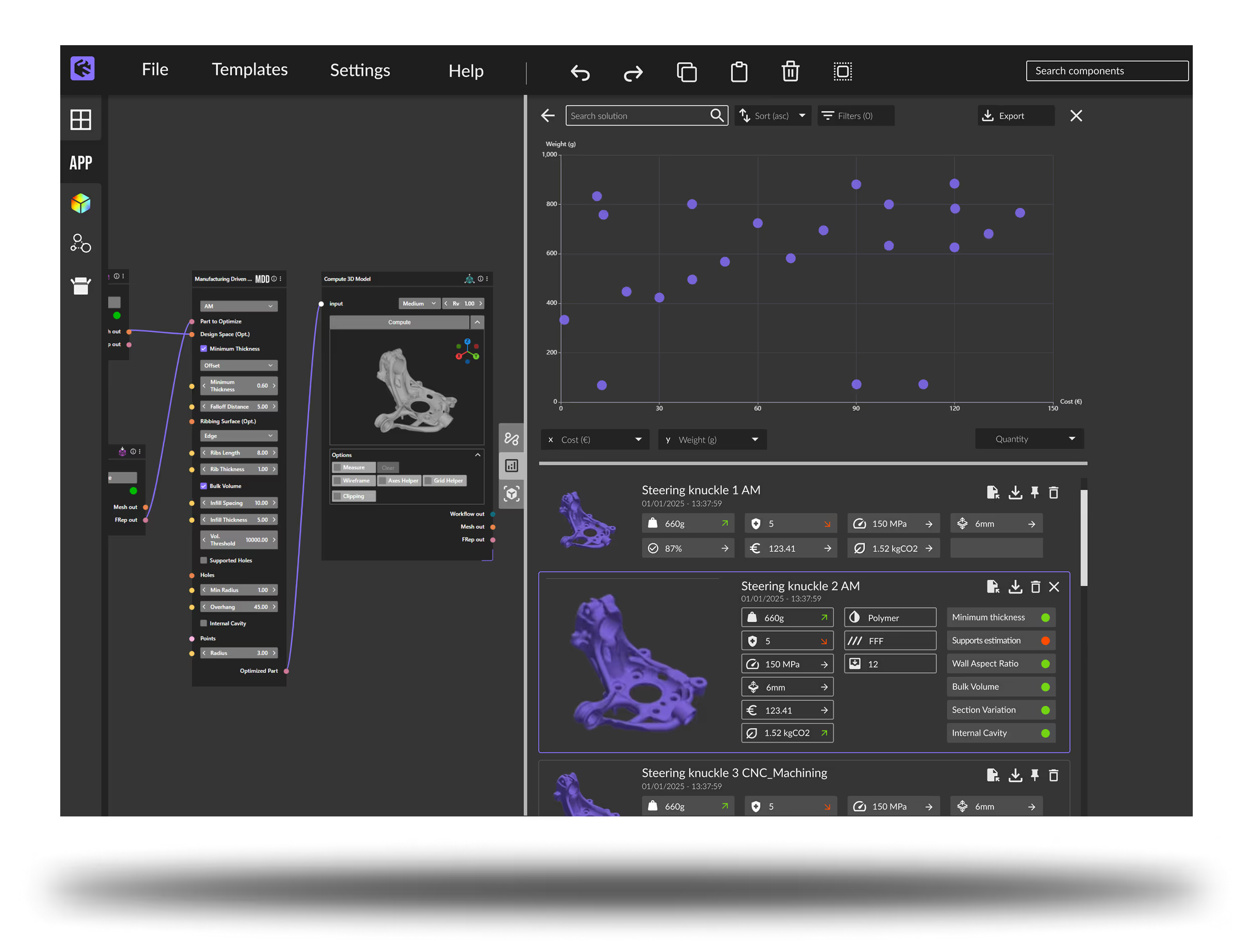

Accelerate design with flexible, data-driven workflows
Adjust optimization parameters freely anywhere without disrupting downstream and upstream design work.
Collaborate seamlessly with shareable, reusable processes
Share secure, reusable workflows that connect teams, streamline processes, and accelerate engineering performance.
Power concurrent engineering with the right platform
Manage multidisciplinary design intents in one platform throughout the product development cycle

Thanks to Cognitive Design, we were able to rapidly design and validate a structurally optimized tank that fits within our CubeSat constraints, integrates all required functions, and meets demanding pressure requirements. It’s a game-changer for enabling component design exploration high-performance propulsion in small satellite platforms.
Unlock Your Design Potential
Request a demo to see how Cognitive Design by CDS can revolutionize your engineering workflow
We shift the engineering paradigm
From concept to production, every decision is traceable, auditable, and connected, linking engineering insights and environments into one unified digital workflow.
Organization - Integrate & Accelerate
Keep design objectives aligned across disciplines by centralizing requirements, decisions, and constraints in one environment. Maintain clear traceability and drive efficient collaboration from initial concept through final production.
CAD
Costing
Sustainability
MBSE
Configuration Management
Engineering Team - Share & Increment
Enable engineering teams to work seamlessly by sharing secure, reusable workflows that standardize processes, preserve expertise, and accelerate development. Facilitate efficient collaboration while safeguarding critical design optimization data.
Test Data
Digital Twins
FEA
Engenering Data
Engineers - Create & Optimize
Accelerate your engineering workflows with customizable, data-centric processes that enable you to explore, validate, and optimize high-performance parts faster. Integrate design, simulation, and manufacturing data to reduce development cycles.
Manufacturing
Lightweighthing
Verstile workflows
Explore Our Key Industries and Expertise
Cognitive Design by CDS specializes in delivering innovative solutions for critical industries. Our software empowers design engineers to optimize parts for aerospace, automotive, and defense sectors.


The combination of key enablers to accelerate design
Our next-generation geometric kernel leverages implicit modeling technology, enabling ultra-fast, robust modeling of complex, manufacturable geometries, overcoming the limitations of traditional boundary representations.
This is complemented by our advanced parametric workflows, manufacturing automation modules, and AI-driven multi-objective generative optimization, together creating a comprehensive, data-driven platform for high-performance, manufacturable product design
FAQs
Explore our frequently asked questions to understand how our software can benefit you.
Engineers typically become productive within one to two weeks of training. The intuitive interface builds on familiar CAD concepts while structured courses cover optimisation setup, manufacturing constraints, and workflow automation.
Cognitive Design generates customisable reports including design summaries, comparison matrices, and performance charts. Reports export to standard formats for integration into technical documentation and project deliverables.
Engineers generate first optimised concepts within a few hours of defining requirements using Cognitive Design. Traditional approaches requiring manual CAD modelling and separate simulation take days or weeks to reach equivalent design maturity.
Cognitive Design exports optimised geometries in industry-standard formats including STEP, STL, and native CAD formats. The platform maintains high geometric fidelity during export, ensuring seamless integration with downstream CAD/CAM systems and manufacturing workflows.
Cognitive Design is an AI-powered concept exploration platform for mechanical and thermo-mechanical parts. It combines generative design, topology optimisation, and integrated simulation to accelerate the design phase while ensuring manufacturing feasibility from the start.
Cognitive Design offers flexible deployment including on-premise installation and private cloud options. On-premise deployment ensures complete data sovereignty, meeting security requirements of aerospace, defence, and regulated industries.
Cognitive Design reduces concept phase duration from 24-38 weeks to 4-6 weeks typically. By running simulation and manufacturability checks concurrently with design exploration, engineers eliminate sequential iteration delays that dominate traditional workflows.
Weight reductions of 30-45% directly reduce material costs and improve product performance. In aerospace and automotive applications, lighter parts also reduce operational costs through improved fuel efficiency over product lifetime.
Projects using Cognitive Design meet milestones more predictably by front-loading design exploration. Reduced iteration loops and earlier issue detection prevent schedule overruns that plague traditional development approaches.
On-premise deployment installs Cognitive Design entirely within customer infrastructure. All design data, optimisation results, and intellectual property remain on local servers with no external data transmission required.
Cognitive Design exchanges data with major CAD platforms through standard formats like STEP and IGES. Optimised geometries import directly into SolidWorks, CATIA, NX, or Creo for detailed design refinement and documentation.
Thorough virtual exploration reduces physical prototype iterations by 40-60%. Each avoided prototype cycle saves thousands in tooling, material, and testing costs while accelerating development timelines.
Every design decision in Cognitive Design is automatically documented with full parameter history. Engineers can trace any geometry back to its input requirements, constraints, and optimisation settings, supporting quality audits and regulatory compliance.
Cognitive Design generates comprehensive reports showing design evolution, trade-off analyses, and performance summaries. Interactive visualisations and comparative charts support effective design review meetings with technical and management stakeholders.
Unlock Your Design Potential
Request a demo to see how Cognitive Design by CDS can revolutionize your engineering workflow